August 8, 2026
5 Common Mistakes to Avoid When Taking Probiotics
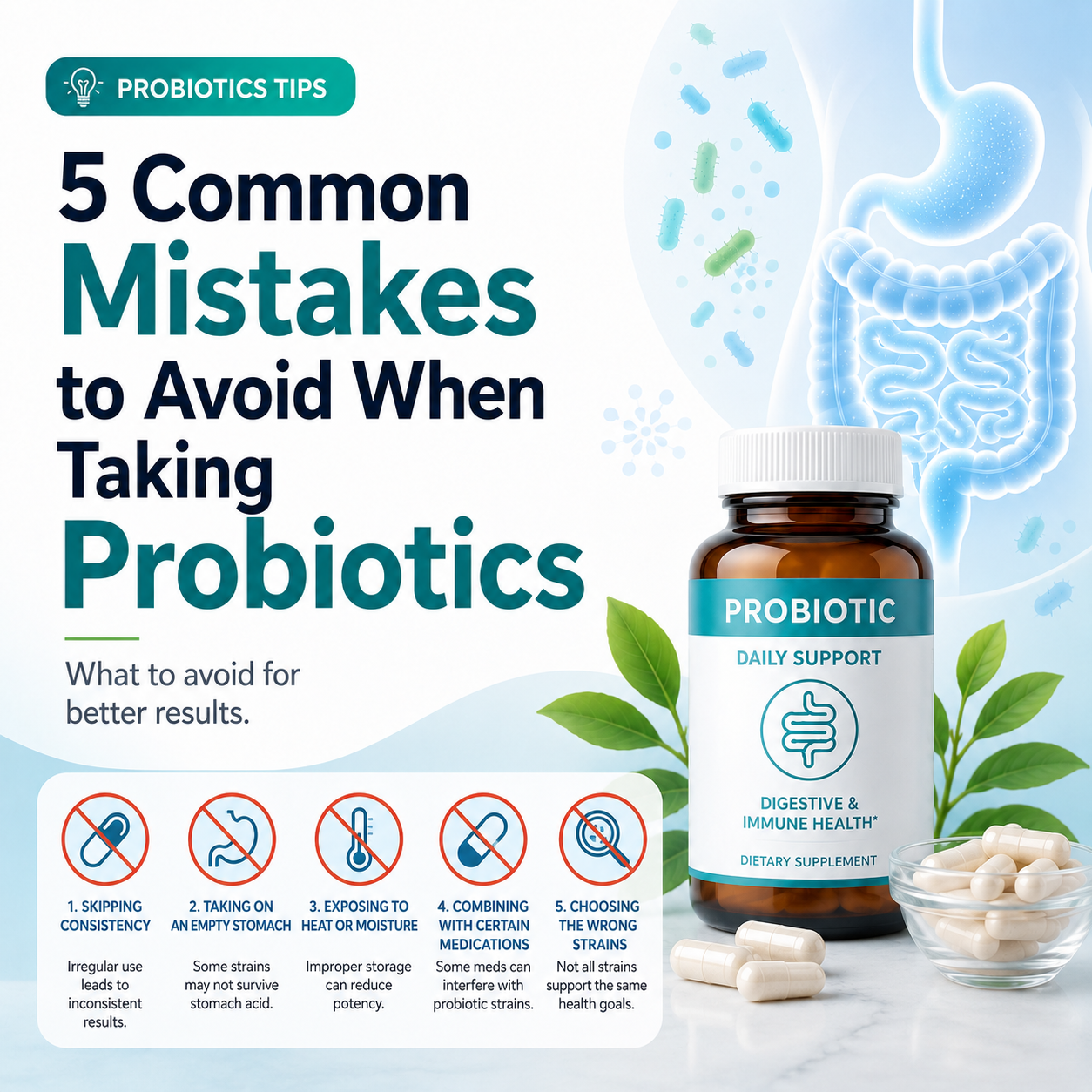
The global probiotic market surpassed $65 billion in 2023, according to Grand View Research, and supplements account for a growing portion of that figure. Yet despite widespread availability, a significant gap remains between purchase and actual health benefit. Product returns and consumer complaints frequently point to one root cause: usage errors rather than formulation failure.
For manufacturers, contract packagers, and brand managers, understanding the most common mistakes when taking probiotics is not just a consumer education issue—it is a product stewardship and brand loyalty requirement. This article dissects five well-documented errors, grounds them in published science, and explains how the industry can address them through smarter labelling, formulation, and communication.
Table of Contents
Introduction
Mistake 1 – Ignoring Strain Specificity
Mistake 2 – Improper Storage and Handling
Mistake 3 – Taking Probiotics at the Wrong Time
Mistake 4 – Overemphasizing CFU Count Alone
Mistake 5 – Inconsistent Use and Premature Discontinuation
At-a-Glance: Do’s and Don’ts Table
Real-World Impact: How a Label Change Reduced Returns
Frequently Asked Questions
Conclusion and Industry Takeaways
1. Introduction
Probiotics are defined by the International Scientific Association for Probiotics and Prebiotics (ISAPP) as “live microorganisms that, when administered in adequate amounts, confer a health benefit on the host.” This definition underscores three non-negotiable pillars: the microbes must be alive, in sufficient quantity, and strain-specific for a given health outcome. When consumers unknowingly violate one or more of these conditions, the result is almost always the same—a capsule that passes through the gut without effect. For B2B stakeholders, every ineffective dose is a threat to repeat purchase rates and category credibility. The following five mistakes are responsible for the bulk of underperformance reported in post-market surveillance and consumer hotline data.
2. Mistake 1 – Ignoring Strain Specificity
A 2020 survey by the Council for Responsible Nutrition (CRN) found that only one in three dietary supplement users in the United States could name the specific probiotic strain they were taking. Many consumers operate under the assumption that all probiotics work the same way. This is arguably the most fundamental mistake when taking probiotics, and it explains a large share of “it didn’t work for me” anecdotes.
Probiotic effects are strain-specific and cannot be extrapolated from one species to another. Lactobacillus rhamnosus GG, for example, has over 30 years of clinical evidence for managing acute gastroenteritis, while Bifidobacterium lactis BB-12 shows the most consistent results in immune modulation and digestive comfort. Both are excellent organisms, but swapping one for the other without aligning to the intended health endpoint undermines efficacy. ISAPP’s 2014 consensus statement explicitly notes that “health benefits demonstrated for one strain cannot be assumed for another, even within the same species.”
For formulators, this means that a blend with five strains listed only to the genus level does little for the educated buyer. More brands are now printing the full strain designation—genus, species, and alphanumeric code—directly on the front-of-pack label. This simple step helps consumers and healthcare practitioners match the product to the symptom, sharply reducing the “wrong strain” mistake.
Keyword tip: probiotic strain specificity becomes a key long-tail phrase that both consumers and industry professionals search when evaluating quality.
3. Mistake 2 – Improper Storage and Handling
Live probiotics are thermolabile and hygroscopic. When storage instructions are ignored, the colony-forming unit (CFU) count on the label can rapidly become a fiction. A 2014 study published in Beneficial Microbes demonstrated that certain freeze-dried Lactobacillus and Bifidobacterium strains lost more than 50% of their viability after six months of storage at room temperature (25 °C) compared to refrigerated control samples. In 2018, ConsumerLab.com tested 19 probiotic supplements and found that four products contained less than 30% of the listed viable organisms—not because they were manufactured poorly, but because they had degraded during warehousing or transit.
For the end user, the mistake is straightforward: a bottle labelled “refrigerate after opening” left on a warm kitchen counter for weeks. A growing segment of shelf-stable probiotics avoids this vulnerability through advanced encapsulation and desiccant-lined packaging, but even these products have temperature limits.
ASTM F1980 provides an accelerated aging standard that many contract manufacturers use to model shelf-life under fluctuating conditions. Brands that omit temperature-sensitive warning icons or store the finished goods in non-climate-controlled fulfilment centers amplify the risk. Clear labelling and consumer education about proper handling of live probiotic supplements are among the cheapest insurance policies against efficacy complaints.
4. Mistake 3 – Taking Probiotics at the Wrong Time
Meal timing relative to probiotic ingestion has been studied intensively. The goal is to maximize microbial survival through the stomach’s acidic barrier. A frequently cited 2011 trial led by Tompkins et al., published in Beneficial Microbes, measured the survival of a commercial probiotic in an artificial stomach model. The results were striking: when taken 30 minutes before a meal containing 1% fat, the simulated gastric survival rate was approximately 20%.
When consumed with the same meal, survival rose to over 30%. With a meal containing 3% fat, survival approached 50%. Conversely, ingestion on an empty stomach—especially after a prolonged fast—exposed the cells to a peak-acid environment that reduced viability to low single digits.
A related and equally common error is the timing of probiotics with antibiotics. In a 2019 survey published in the Journal of the American Pharmacists Association, only 29% of patients receiving an oral antibiotic recalled being advised to separate probiotic intake by at least two hours.
Taking a probiotic simultaneously with a bactericidal antibiotic can destroy the very organisms being supplemented. Best-practice guidance from the World Gastroenterology Organisation (2017) recommends a minimum interval of two to three hours between an antibiotic dose and a probiotic supplement. The message for consumers must be unambiguous: probiotics need a food buffer, and they cannot be swallowed alongside a morning antibiotic dose.
5. Mistake 4 – Overemphasizing CFU Count Alone
Higher CFU numbers sell bottles, but CFU count without context is a marketing metric, not a clinical one. A 2021 meta-analysis in Probiotics and Antimicrobial Proteins reviewed 35 randomized controlled trials and found no linear relationship between CFU dose and efficacy above the threshold needed for a specific indication.
Some strains are effective at 100 million CFU per day; others require 10 billion. Yet consumer comments on e-commerce platforms frequently indicate a belief that “50 billion is twice as good as 25 billion.”
The mistake compounds when consumers ignore the “CFU until expiry” distinction. Some labels boast 50 billion CFU “at time of manufacture.” Under suboptimal storage, that number can plummet long before the best-before date. A 2019 report by the UK’s Medicines and Healthcare products Regulatory Agency (MHRA), focusing on border testing of imported supplements, noted multiple instances where viable counts were below 10% of the declared value despite the product being within its shelf-life.
Procurement professionals specifying custom blends should insist on overage calculations and real-time stability data—not just the maximum-count-at-day-zero figure. Educating the consumer to value stability over initial CFU is a long-term play, but one that directly addresses the “why did it stop working for me?” inquiry.
6. Mistake 5 – Inconsistent Use and Premature Discontinuation
Probiotics rarely act overnight. Most gastrointestinal applications require a colonization or modulation phase lasting two to four weeks before self-reported symptoms improve. A 2020 consumer habits survey by the International Food Information Council (IFIC) revealed that 48% of probiotic users stopped taking the product within 14 days if they did not notice a tangible difference.
This pattern of inconsistent use and premature discontinuation is perhaps the most wasteful mistake in the category. The same IFIC data showed that those who continued for at least 30 days were three times more likely to report satisfaction and repurchase.
For brands, the takeaway is not simply to print “take daily” on the box. It is about setting realistic expectations through every touchpoint—product page, chatbot, and label insert. A two-sentence expectation-setter (“Most users notice gradual improvements over 3-4 weeks.
Some may experience temporary bloating during the first week.”) can dramatically reduce early drop-off. This approach moves the conversation from “defective product” to “predictable adaptation,” protecting both the brand’s reputation and the consumer’s health outcome.
7. At-a-Glance: Do’s and Don’ts Table
Common Mistake | The Evidence | What to Do Instead |
Ignoring strain specificity | ISAPP, 2014: effects are strain-specific. | Match the strain to the health need; look for full strain identifiers on the label. |
Storing probiotics incorrectly | Beneficial Microbes (2014): 50% loss at 25 °C over six months. | Follow on-pack storage instructions; never leave the bottle in direct sunlight or near a heat source. |
Taking at the wrong time | Tompkins et al. (2011): survival improves with food. | Take with a meal containing some fat, or 30 minutes before eating. |
Worrying only about high CFU | MHRA 2019 border report: many products fall short of label claim. | Choose products that guarantee CFU until expiry, not just at manufacture. |
Stopping too early or missing days | IFIC 2020: 48% quit within 2 weeks if no effect. | Commit to at least four weeks of daily use; set a phone reminder. |
8. Real-World Impact: How a Label Change Reduced Returns
In 2022, a mid-sized dietary supplement contract manufacturer in the Midwest region of the United States conducted a root-cause analysis of customer returns for a white-label probiotic line. Their internal data showed that 34% of returns cited “no noticeable benefit.” When the quality team examined the returned units, most still met the labelled CFU specification at the time of return, ruling out a simple potency failure.
The manufacturer’s brand owner, in collaboration with a regulatory consultant, made three changes:
The front label began displaying the full strain designation (e.g., Lactobacillus plantarum Lp299v instead of merely “Lactobacillus plantarum”).
A storage icon with a thermometer was added next to the supplement facts panel, and a red text line instructed, “Refrigerate after opening for maximum potency.”
A peel-back label segment explained, “Give it 3-4 weeks—probiotics work gradually,” and included a QR code linking to a short video on when and how to take the product.
Within 12 months of implementing these changes, the “no benefit” return rate fell to 18%, and the brand’s online rating improved from 3.8 to 4.3 stars across major platforms. The case, which was presented at a SupplySide West educational session in 2023, underscores a hard truth: product efficacy and consumer education are inseparable.
9. Frequently Asked Questions
How long does it take for probiotics to work?
Most studies show measurable gastrointestinal improvements after two to four weeks of daily use. Some conditions, such as antibiotic-associated diarrhea prevention, may respond within the first few days. Persistence matters more than a megadose.
Can I take probiotics with a hot beverage?
Heat above 46 °C can quickly kill probiotic microorganisms. Stirring a powdered probiotic into coffee or tea just off the boil is a sure way to destroy the majority of viable cells. Always add probiotics to cooled or room-temperature liquids and foods.
Is it safe to take probiotics during antibiotic treatment?
Yes, and it is often recommended to reduce the risk of antibiotic-associated diarrhea. The critical rule is to separate the doses by at least two hours. Consult the 2017 World Gastroenterology Organisation guideline for condition-specific strain recommendations.
What does “CFU at time of expiry” mean?
It guarantees that the product will deliver at least the declared number of live organisms until the labeled use-by date if stored correctly. This figure is more reliable than a count taken only at the time of manufacture.
Do I need to take probiotics every day?
For most applications, daily supplementation supports consistent gut colonization and physiological effect. A systematic review by Derrien and van Hylckama Vlieg (2015) noted that once-a-day intake is sufficient to maintain measurable fecal recovery of supplemented strains.
10. Conclusion and Industry Takeaways
Common mistakes when taking probiotics are not inevitable. They are symptoms of an information gap between the laboratory and the medicine cabinet. By addressing strain specificity, storage conditions, meal timing, CFU stability, and adherence expectations directly on packaging and in marketing materials, brands can lift efficacy rates, lower return percentages, and build durable trust.
For manufacturers and brand owners seeking to develop or refine a probiotic line, the checklist is straightforward: full strain transparency, validated stability data, clear graphical usage instructions, and an honest timeline of expected results. If you are sourcing custom probiotic blends, reviewing your label’s consumer-education elements, or planning a clinical study to back your claims, our technical team can connect you with formulation resources and current shelf-life testing protocols.
Reach out to start the conversation—because a product that works only when used correctly is a product the industry must help consumers use correctly.
References
Hill, C. et al. (2014). The International Scientific Association for Probiotics and Prebiotics consensus statement on the scope and appropriate use of the term probiotic. Nature Reviews Gastroenterology & Hepatology, 11, 506–514.
Tompkins, T.A., Mainville, I., & Arcand, Y. (2011). The impact of meals on a probiotic during transit through a model of the human upper gastrointestinal tract. Beneficial Microbes, 2(4), 295–303.
Council for Responsible Nutrition (CRN). 2020 CRN Consumer Survey on Dietary Supplements. Available at crnusa.org.
International Food Information Council (IFIC). 2020 Food and Health Survey. Available at foodinsight.org.
Medicines and Healthcare products Regulatory Agency (MHRA). (2019). Borderline and unlicensed dietary supplement testing report. UK Government.
World Gastroenterology Organisation. (2017). Probiotics and prebiotics global guidelines. Available at worldgastroenterology.org.
ConsumerLab.com. (2018). Probiotic Supplements Review. Available at consumerlab.com.
Grand View Research. (2023). Probiotics Market Size, Share & Trends Analysis Report, Market Analysis Report GVR-1-68038-642-3.