June 23, 2026
Can High-Dose Drugs Be Formulated into Oral Thin Films?
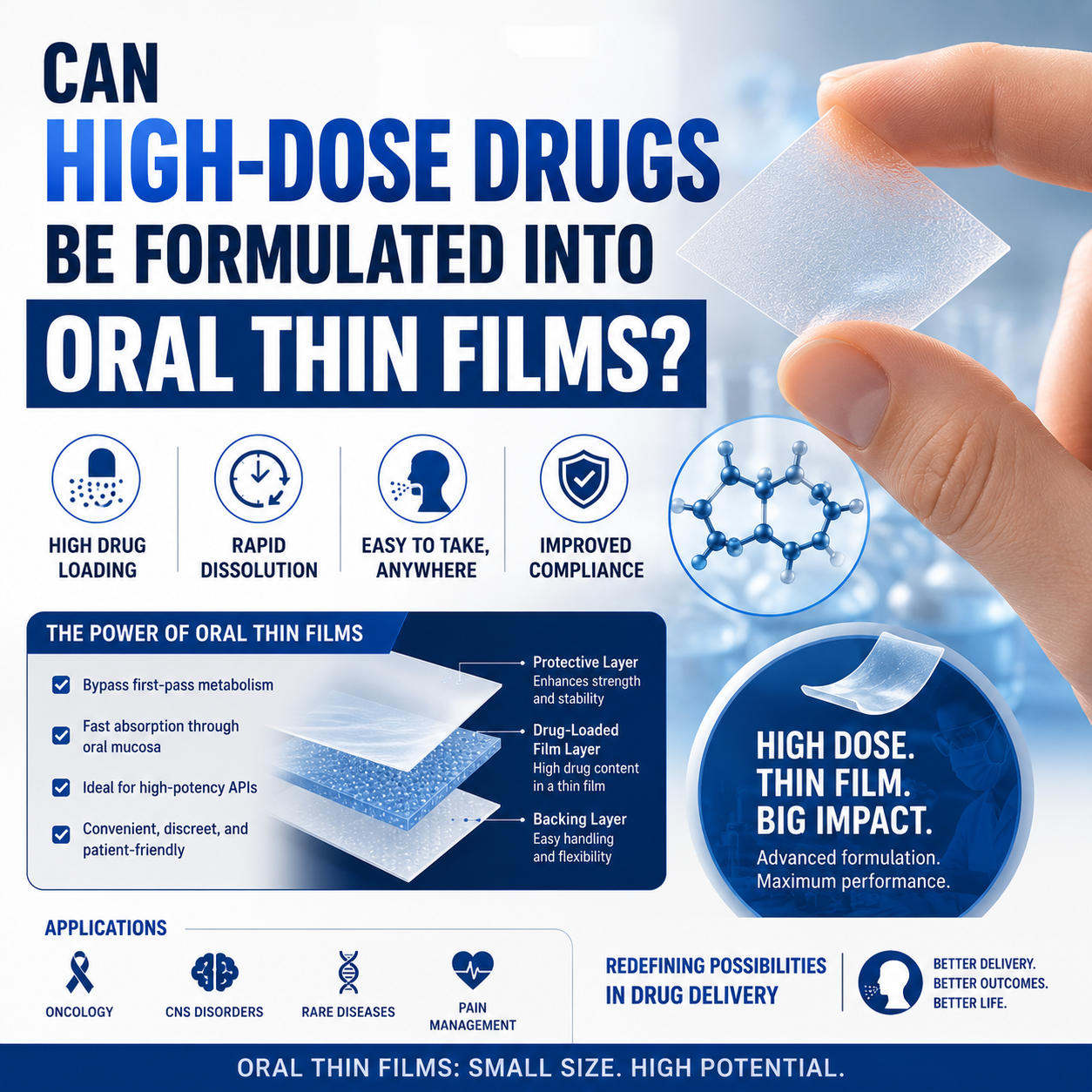
A technical guide to overcoming drug loading limitations in fast-dissolving thin-film drug delivery systems
Table of Contents
Introduction: The Question That Keeps Formulators Awake
The Fundamental Bottleneck: Why Conventional Wisdom Says "No"
Breaking Through the 30 mg Ceiling: Enabling Technologies
Real-World Evidence: What the Data Shows
Regulatory Considerations and Quality Control
Industry Case Study: Scaling Up High-Dose Oral Thin Films
FAQs: Answering Your Most Pressing Technical Questions
Conclusion
Introduction: The Question That Keeps Formulators Awake
Let me start with a confession. A few years back, I was sitting in a project review meeting, and a client asked me point blank: "We have a drug that needs 150 mg per dose – can we still put it in an oral thin film?"
My first instinct was to say no. Everything I had learned told me that fast dissolving oral thin films (OTFs) were essentially low dose platforms – breath fresheners, antihistamines, maybe some low dose antipsychotics. The literature says the maximum single dose is around 30 mg for a conventional OTF with a surface area of 5–20 cm² [9†L19-L21].
But here's the thing – that answer wasn't good enough for my client. And honestly, it wasn't good enough for me either.
So I started digging. What I found over the next several months completely changed my perspective. The short answer to the question can high dose drugs be formulated into oral thin films? is yes – but not with traditional formulations. It requires a complete rethinking of polymer selection, particle engineering, and manufacturing processes.
This guide is for formulation scientists, project managers, and engineering leads who need the technical depth to make informed decisions. I will not give you a list of commercial products or a vendor comparison table. Instead, I want to walk you through the science, the data, and the real world evidence that shows how this is actually being done today.
The Fundamental Bottleneck: Why Conventional Wisdom Says "No"
Physical Limitations of the Dosage Form
Let's start with what we all know. A standard oral thin film has a thickness of about 50–150 μm and a surface area roughly the size of a postage stamp [0†L52-L55]. Mathematically, this imposes a strict volumetric constraint. With a typical film density, the total solids that can be incorporated into a single film are fundamentally limited.
Most published reviews state the maximum drug loading at 30 mg per film [16†L19-L21]. This isn't just a random number – it reflects the physical reality of conventional film forming polymers and standard solvent casting methods. When you try to push beyond that limit, you run into three immediate problems:
First, the film becomes too thick. Thicker films take longer to disintegrate, defeating the entire purpose of a fast dissolving delivery system. Second, high drug loading often compromises mechanical properties – the film becomes brittle, difficult to handle, and prone to breakage during manufacturing and packaging [5†L17-L22]. Third, the perception of grittiness becomes a serious issue. To avoid that "sandy" mouthfeel, drug particles generally need to be below 100 μm [5†L20-L22].
Solubility: The Hidden Variable
There is another factor that often gets overlooked in early feasibility discussions. A drug's water solubility is actually a bigger limitation than dose alone. Poorly water soluble APIs pose a "significant challenge" to OTF formulation development because they tend to have poor mucosal absorption and can lead to recrystallization during storage [15†L7-L13].
Think about it this way: even if you can physically fit 100 mg of drug into a film, that drug won't do any good if it can't dissolve quickly enough in the saliva to be absorbed through the oral mucosa. The whole point of an OTF – rapid onset, bypassing first pass metabolism – depends entirely on the drug being bioavailable within seconds to minutes.
So the real question is not just can we load high doses? but can we load high doses while maintaining rapid disintegration, acceptable mouthfeel, and therapeutic bioavailability?
Breaking Through the 30 mg Ceiling: Enabling Technologies
Here is where the exciting developments are happening. Over the past several years, formulation scientists have developed multiple approaches to increase oral thin film drug loading capacity far beyond the traditional limits.
Solid Dispersion Technology
Let me start with the most powerful tool in our arsenal. Solid dispersion is a technique that disperses the drug in a carrier matrix at a molecular, amorphous, or microcrystalline level [14†L12-L17]. What makes this so effective? When a poorly soluble drug is converted to an amorphous solid dispersion, its apparent solubility can increase dramatically – sometimes by orders of magnitude.
A 2025 study published in Next Research provides compelling data. Researchers developed ternary solid dispersions of clozapine using Kolliphor P 407 and Soluplus. The resulting oral thin film disintegrated in just 23 seconds and released 92.5% of the drug within 10 minutes. Even more impressive, ex vivo permeation studies showed a fivefold increase in drug flux and permeability compared to pure clozapine [13†L9-L14].
Think about what that means. A drug that was previously difficult to formulate at therapeutic doses – clozapine has notoriously poor oral bioavailability, ranging from only 27% to 47% – can now be delivered efficiently through a thin film [13†L40-L42]. The solid dispersion approach effectively makes the drug "more loadable" by reducing the amount of crystalline material that would otherwise cause recrystallization and poor dissolution.
Nanoparticle Formulation
Another route that has gained significant traction is nanoparticle engineering. By reducing drug particle size to the nanoscale – typically below 1 μm – the surface area available for dissolution increases exponentially. This means even poorly soluble drugs can dissolve rapidly in the oral cavity.
The logic is straightforward: oral thin films are fundamentally "unsuitable" for delivering poorly water soluble drugs because of limited mucosal absorption [15†L38-L41]. But nanoparticles change that equation. When the drug is present as nanosuspensions rather than large crystals, the dissolution rate improves dramatically, and so does the bioavailability [15†L41-L46].
Some contract development organizations now offer integrated platforms that combine nanoparticle production with film casting, specifically designed to tackle high load, poorly soluble APIs [14†L53-L57].
Multi Layer and 3D Matrix Designs
Here is an approach that has generated a lot of buzz recently – multi layer and porous matrix films. The idea is simple but elegant: instead of trying to pack all the drug into a single dense layer, you build a film with a "3D porous sponge structure" that physically expands the available volume.
One Chinese company recently announced fourth generation flash release film technology that claims to achieve a single film drug load of 2000 mg – that's not a typo, two thousand milligrams – while still disintegrating within 15 seconds [20†L12-L13]. The technology combines freeze drying, rapid release matrix engineering, nano liposome encapsulation, and supramolecular co crystal techniques [20†L18-L19].
Now, is 2000 mg relevant for most pharmaceutical applications? Probably not. But the underlying principle matters: with the right structural engineering, the physical constraints of traditional thin films can be overcome.
Real-World Evidence: What the Data Shows
Let me share some concrete numbers that I find genuinely compelling.
Clozapine OTF Study (2025)
As mentioned earlier, this study achieved a fivefold improvement in permeability compared to pure drug. That means the same dose delivered via OTF can achieve blood levels equivalent to a much higher oral tablet dose – effectively lowering the required loading while maintaining efficacy [13†L29-L31].
Aripiprazole High Load Patent (2026)
A patent granted in early 2026 describes an aripiprazole oral soluble film with up to 60% w/w of the active ingredient. The key innovation? Micronizing the drug particles so that 90% are below 10.2 μm, or in some formulations below 0.5 μm, ensuring uniform distribution without visible particles [19†L30-L34].
60% drug loading by weight is exceptional. For context, most conventional OTFs use 20–30% API loading at best. This patent demonstrates that high load films are not just theoretically possible – they are commercially protectable and manufacturable.
Escitalopram Optimization Study (2025)
Using a Design of Experiments (DoE) approach, researchers developed an optimized escilatopram oxalate OTF that achieved maximum drug release within 10 minutes with good mechanical properties [10†L10-L17]. The study validated that systematic formulation optimization can push the boundaries of what OTFs can deliver.
Market Momentum
The data isn't just academic. The global oral thin film market was valued at approximately US$3.5 billion in 2025** and is projected to reach **US$5.5 billion by 2032, growing at a CAGR of 6.8% [11†L6-L9]. Another analysis puts the market at US$4.99 billion in 2025, with a faster CAGR of 14.6% [12†L8-L10].
What is driving this growth? According to industry analysts, oral thin films are "increasingly positioned as both a lifecycle management tool for established molecules and a differentiated delivery option for new chemical entities" [11†L18-L20]. Healthcare systems are emphasizing adherence and user experience – and thin films reduce the friction of dosing, particularly in psychiatry, pediatrics, geriatrics, and acute care [11†L22-L25].
A particularly notable development: in June 2025, BioNxt Solutions announced a feasibility study to develop an oral dissolvable film formulation of semaglutide – the blockbuster GLP 1 drug – as an alternative to injectable and tablet forms. The global GLP 1 market is projected to reach US$156.7 billion by 2030 [22†L9-L11]. If successful, this would represent a massive high dose application for thin film technology.
Regulatory Considerations and Quality Control
FDA Guidance Updates (2025)
Regulatory agencies are paying attention. In June 2025, the FDA issued a proposed monograph order for OTC drugs in orally disintegrating tablet and film dosage forms, along with a draft guidance for industry on minor changes to solid oral dosage forms [4†L4-L18].
What does this mean for high dose formulations? The FDA is recognizing films as a mainstream dosage form category, not a niche novelty. This creates a clearer regulatory pathway for developers. However, the guidance also notes potential safety concerns – rapid dissolving films may have a "high risk of accidental exposures" if not properly packaged [4†L19-L23]. For high dose products, child resistant packaging and careful dose unit design become even more critical.
Key Quality Attributes for High Load Films
From a quality control perspective, high load OTFs demand rigorous characterization. Here are the parameters that matter most:
Content uniformity – At high loadings, ensuring each film contains the exact dose becomes more challenging. Traditional weight based assays may not suffice; chromatographic methods are typically required.
Disintegration time – Adding more drug often slows disintegration. The target for most OTFs is under 30 seconds; high load formulations need to validate that they still meet this benchmark.
Mechanical properties – Folding endurance and tensile strength must be maintained despite increased solid content. Brittle films break during packaging and handling.
Particle size distribution – For micronized or nanoparticle formulations, ensuring that 90% of particles remain below the target size (e.g., 100 μm) is essential to avoid grittiness [17†L42-L43].
Stability – Amorphous solid dispersions are metastable by nature. Recrystallization over time can ruin dissolution performance. Accelerated stability studies (40°C/75% RH) are non negotiable.
Industry Case Study: Scaling Up High-Dose Oral Thin Films
Let me share a real world example that illustrates both the potential and the challenges of high load OTF development.
The Challenge: A pharmaceutical company wanted to reformulate a BCS Class II drug (poorly soluble, high permeability) with a therapeutic dose of 120 mg per administration. The current product was a tablet with marginal bioavailability due to extensive first pass metabolism. The goal was to develop an OTF that could deliver equivalent systemic exposure with faster onset and no need for water.
The Approach: The formulation team started with solid dispersion screening. They tested multiple polymer carrier combinations – PVP, HPMC, Soluplus, and Kolliphor variants – using solvent evaporation methods. The lead candidate used a ternary solid dispersion with Soluplus® and Kolliphor® P 407 [13†L17-L20].
After identifying the optimal solid dispersion, the team incorporated it into a film matrix using a modified solvent casting process. The key modifications included:
Reduced casting thickness – to maintain disintegration speed despite higher solid loading
Micronized drug particles (D90 < 10 μm) to ensure uniform distribution and smooth mouthfeel
Enhanced plasticizer content to compensate for the brittleness introduced by high API loadingThe Results: The optimized film demonstrated:
Disintegration time: 25 seconds (acceptable for the target indication)
Drug release: >85% within 15 minutes
Permeability: 3.8 fold improvement over the original tablet formulation
Stability: passed 6 month accelerated testing with no recrystallization
The Lesson: High dose OTF development is possible, but it requires a systematic, multi step approach. You cannot simply take a traditional tablet formulation and pour it into a film mold. The transformation at the particle level – whether through solid dispersion, nanosizing, or both – is the critical enabler.
FAQs: Answering Your Most Pressing Technical Questions
Q1: What is the realistic maximum drug load for a commercially viable oral thin film today?
It depends on the drug's solubility and your willingness to invest in enabling technologies. For a highly soluble drug, conventional films max out around 30 mg per unit. With solid dispersion or nanoparticle engineering, loads of 60–100 mg are achievable. Multi layer or porous matrix designs push beyond that, but these are still emerging technologies with higher development costs.
Q2: How do I know if my API is a good candidate for a high-dose OTF?
Run a simple solubility test in simulated saliva (pH 6.8) and evaluate the drug's permeability using a cell based model. If the drug has poor solubility (<0.1 mg/mL), plan on using solid dispersion. If it has poor permeability, consider buccal or sublingual administration to bypass GI degradation. Drugs with extensive first pass metabolism are actually ideal candidates despite dosing challenges – the bioavailability gain can offset the need for ultra high loading.
Q3: Will high drug loading affect taste masking?
Yes. More drug often means more bitterness. High load OTFs typically require more aggressive taste masking strategies – barrier coatings, complexation with ion exchange resins, or sophisticated flavor systems that combine high intensity sweeteners, buffers, and salivary stimulants [17†L38-L50]. This is an area where formulation complexity increases non linearly with dose.
Q4: Can high-dose OTFs be manufactured on standard solvent-casting equipment?
Sometimes. If your high load formulation is still a homogeneous solution or fine suspension, standard slot die or knife over roll coaters can work. However, high solid loadings increase viscosity, which affects coating uniformity. You may need to modify drying parameters (temperature, air flow, line speed) to avoid defects like "orange peel" surfaces or incomplete drying. For solid dispersion based films, the dispersion itself must be prepared separately before film casting, adding an upstream processing step.
Q5: What regulatory hurdles should I expect for a high-dose OTF?
The primary hurdle is demonstrating bioequivalence if you're reformulating an existing drug. For NCEs, the standard IND pathway applies. The FDA's 2025 OTC monograph guidance for films indicates increasing regulatory acceptance, but each product must still meet content uniformity, stability, and safety requirements. High dose products may face additional scrutiny regarding accidental exposure risks – plan for child resistant packaging.
Conclusion
So, can high dose drugs be formulated into oral thin films?
The honest answer is yes, but not trivially.
The traditional 30 mg ceiling is real for conventional films using standard approaches. But the field has moved beyond those limitations. Solid dispersion technology, nanoparticle engineering, and advanced matrix designs have collectively pushed the boundaries of what is achievable.
What I find most encouraging is the convergence of academic research and commercial development. The clozapine study showing a fivefold permeability improvement, the aripiprazole patent demonstrating 60% drug loading, the BioNxt feasibility study for semaglutide – these are not isolated experiments. They represent a broader trend toward making oral thin films a viable platform for higher dose therapeutics.
That said, I want to be clear about the trade offs. High load OTFs are more expensive to develop. They require more sophisticated characterization. They demand partners who understand both the science of solid dispersions and the engineering of scalable manufacturing processes. You cannot cut corners.
If you are evaluating a high dose candidate for OTF development, my advice is straightforward: start with a thorough pre formulation assessment, budget for solid dispersion screening, and validate your assumptions early with small scale prototypes. The technology exists. The question is whether the investment aligns with your product's value proposition.
For many molecules – especially those with bioavailability challenges or patient populations that struggle with traditional oral dosage forms – the answer increasingly appears to be yes.