August 8, 2026
How Long Does It Take for Probiotics to Work? What to Expect
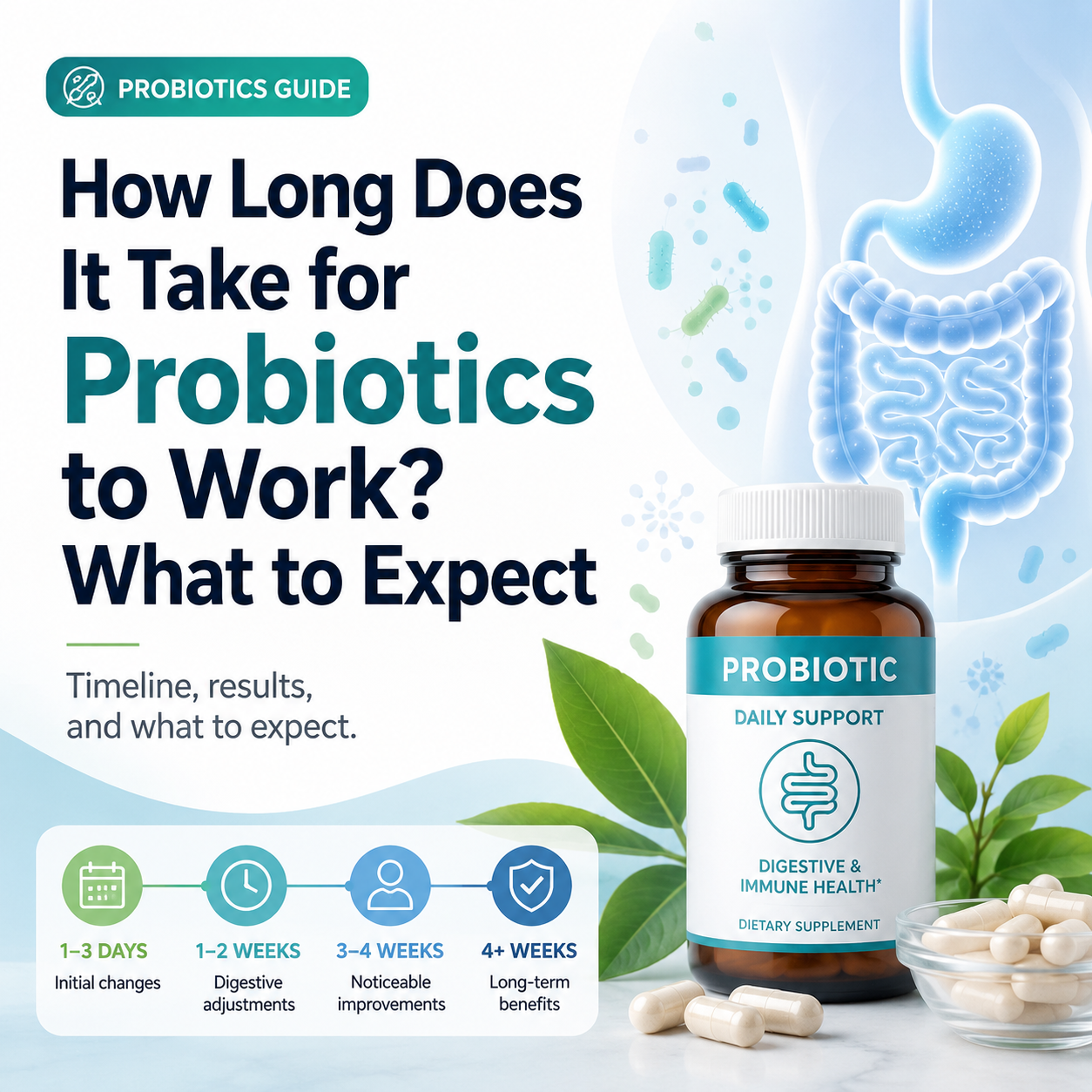
Probiotic supplements rank among the most purchased dietary products worldwide. Yet the question “How long does it take for probiotics to work?” remains the most persistent one consumers type into search engines. A 2020 survey by the Council for Responsible Nutrition found that over half of U.S. adults who take probiotics do so for digestive comfort, but a sizeable proportion stop within a month because they detect no change. Setting an evidence-based timeline helps brand owners manage expectations, reduce returns, and support customer loyalty. This article explains what science tells us about the probiotics timeline, the adjustment period, and what real-world results look like across different health targets.
Table of Contents
The First Week – The Adjustment Period
What Determines How Quickly Probiotics Work
Expected Timeline by Health Goal
Inside a Clinical Trial: 4 Weeks to IBS Relief
Positive Signals That Your Probiotic Is Working
When to Reassess or Switch
Frequently Asked Questions
Conclusion and Industry Perspective
1. The First Week – The Adjustment Period
During the first few days of a new probiotic routine, some people notice nothing. Others experience mild bloating, gurgling, or a temporary change in bowel frequency. These sensations usually reflect the gut microbiota adapting to a fresh influx of live organisms. In a 2014 systematic safety review published in Expert Opinion on Drug Safety, such transient digestive symptoms were the most commonly reported side effect, and they almost always resolved within a week without intervention.
It is important to distinguish this normal adjustment from an intolerance. True adverse reactions to probiotics are rare in healthy individuals. The adjustment window usually spans 3–7 days. If symptoms persist beyond two weeks, it may indicate the strain, dosage, or delivery format needs a rethink. Customer education materials that normalize an initial 5-day settling phase can reduce anxious calls to the support line and early abandonment.
2. What Determines How Quickly Probiotics Work
Several variables influence the probiotics timeline, and skipping over them leads to frustration.
Strain specificity. Lactobacillus rhamnosus GG starts working against acute diarrhea within a day, while certain Bifidobacterium strains targeting constipation need 2–3 weeks of continuous intake to show measurable improvement in stool frequency. The ISAPP 2014 consensus paper stresses that one cannot generalize outcomes from one strain to another.
Health endpoint. Preventing antibiotic-associated diarrhea is a short game; probiotics taken alongside a course of antibiotics can often preserve gut function within 48–72 hours (Goldenberg et al., 2017 Cochrane review). Managing chronic constipation or irritable bowel syndrome is a longer process, typically demanding 3–4 weeks before significant symptom reduction appears.
Dosage and viability. A product that guarantees 10 billion CFU at expiry is more likely to deliver consistent results than one that lists 50 billion CFU at manufacture. Live organisms must survive the stomach to populate the colon, and a strong clinical dose with proven stability accelerates onset.
Individual microbiota. Each person’s gut ecosystem is unique. A 2018 study in Cell by Zmora et al. demonstrated that some individuals’ native microbiota resisted colonization by supplemented probiotics, while others were permissive. This explains why two people taking the same probiotic can report different time-to-response.
3. Expected Timeline by Health Goal
The table below synthesizes findings from multiple randomized controlled trials and meta-analyses. It offers a realistic window for when most users begin to feel a difference.
Health Goal | Typical Onset of Noticeable Effect | Recommended Minimum Trial Period | Key Supporting Reference |
Antibiotic-associated diarrhea prevention | 1–3 days | During antibiotic + 1 week after | Goldenberg JZ et al., Cochrane 2017 |
Acute infectious diarrhea | Reduced duration by about 24 h | 2–5 days | Allen SJ et al., Cochrane 2010 |
Functional constipation | 1–2 weeks for softer stools | 4 weeks | Dimidi E et al., Am J Clin Nutr 2014 |
IBS – bloating & abdominal pain | 2–4 weeks | 8–12 weeks | Ford AC et al., Am J Gastroenterol 2018 |
Occasional bloating / gas | 1–3 weeks | 4 weeks | Ringel-Kulka T et al., J Clin Gastroenterol 2015 |
Immune health (fewer colds) | 3–4 weeks | Throughout season | Hao Q et al., Cochrane 2015 |
Mood / mild anxiety | 4–8 weeks | 12 weeks | Akkasheh G et al., Nutrition 2016 |
These windows are not guarantees. They are averages from controlled conditions where product potency was confirmed. In the real world, storage and timing mistakes can prolong the wait considerably—something addressed in our companion article on common probiotic mistakes.
4. Inside a Clinical Trial: 4 Weeks to IBS Relief
One of the clearest illustrations of the “wait for it” nature of probiotics comes from a landmark trial led by O’Mahony and colleagues at University College Cork, published in Gastroenterology (2005). The study randomized 77 adults with irritable bowel syndrome to receive either Bifidobacterium infantis 35624, Lactobacillus salivarius UCC4331, or a placebo. Over eight weeks, the B. infantis group recorded a clinically significant drop in composite symptom scores—abdominal pain, bloating, and bowel movement difficulty—starting around week two and becoming unambiguous by week four.
Importantly, participants who stopped after four weeks still carried the benefit for another two weeks, suggesting that colonization and metabolic modulation had already stabilized. The placebo group improved slightly but never reached statistical significance. This trial encapsulates what probiotic users should realistically expect: a gradual, cumulative improvement, not an overnight fix. Brands that communicate this study’s timeline in their product pages have a stronger story than those that promise “fast relief.”
5. Positive Signals That Your Probiotic Is Working
Instead of expecting an instant flush, consumers can track subtle signals that indicate the supplement is taking hold.
Bowel regularity. Within 1–2 weeks, many report a more predictable morning bowel movement or a reduction in the uncomfortable urgency that accompanies IBS.
Less bloating after meals. A gradual decrease in post-meal distension is a common sign observed around day 10–14, as shown in the B. infantis trial.
Improved tolerance to trigger foods. Some probiotic users note that foods that previously caused gas no longer do, a change that often takes 3–4 weeks.
Better energy and fewer sick days. Immune-focused probiotics can lower the frequency of winter sniffles after a month (Hao et al., 2015).
Recording daily symptoms on a simple 1–5 scale for two weeks before starting and then during supplementation can make these shifts visible. Data logs also give healthcare practitioners concrete information for follow-up.
6. When to Reassess or Switch
If four weeks pass with no noticeable change, it is worth examining the basics: Was the product stored correctly? Is the daily dose being taken with a meal that contains some fat? Could a concurrent antibiotic or antacid be interfering? Sometimes the issue is not the strain but the delivery mechanism—gastric acid can destroy inadequately protected cells before they reach the small intestine.
Switching to a different strain or a multi-strain blend with a different mechanism of action often makes sense. Consulting a healthcare professional and, if possible, choosing a product backed by a published human study for the target condition increases the odds of a meaningful result.
7. Frequently Asked Questions
Can probiotics work immediately?
For acute indications such as infectious diarrhea, some strains can shorten the episode within 24 hours. For chronic digestive issues, immediate effects are unrealistic. The body needs time to integrate the new microorganisms.
How long does it take for probiotics to work for bloating?
Many users report less bloating after 1–2 weeks. Clinical trials for IBS-related bloating show significant improvements at the 4-week mark.
What if I feel worse during the first few days?
Mild bloating, gas, or slight changes in stool consistency are common and usually subside within a week. If symptoms persist or become severe, discontinue and consult a physician.
Does the form—capsule, powder, or gummy—affect onset time?
Form can matter. Delayed-release capsules may protect more cells through the stomach, potentially delivering a higher functional dose to the gut sooner. Powders mixed with food can also work well if the food provides a buffer.
Is it okay to stop once I feel better?
Most clinical evidence supports ongoing intake. The gut microbiome tends to return to its baseline state within weeks after discontinuation in many studies (Zmora et al., 2018).
8. Conclusion and Industry Perspective
How long does it take for probiotics to work? The honest answer is “it depends”—on the strain, the health goal, and the individual. Acute protection may kick in within a day or two. Meaningful digestive relief usually takes 2–4 weeks, and metabolic or mood-related shifts may require 6–12 weeks. Normalizing a short adjustment period and setting an accurate probiotics timeline in product labeling and marketing can turn a one-time buyer into a loyal user.
For contract manufacturers and brand developers, this means that consumer education is not an afterthought. Stability-verified products, strain-specific claims, and packaging that clearly outlines “when to expect results” are all ingredients of a credible offering. If your next project involves formulating or rebranding a probiotic line, our team can connect you with the latest shelf-life testing protocols, clinical study summaries, and labeling guidance. Let’s make sure your customers know not just what to take, but what to expect.