June 23, 2026
Key Excipients Used in Oral Dissolving Films
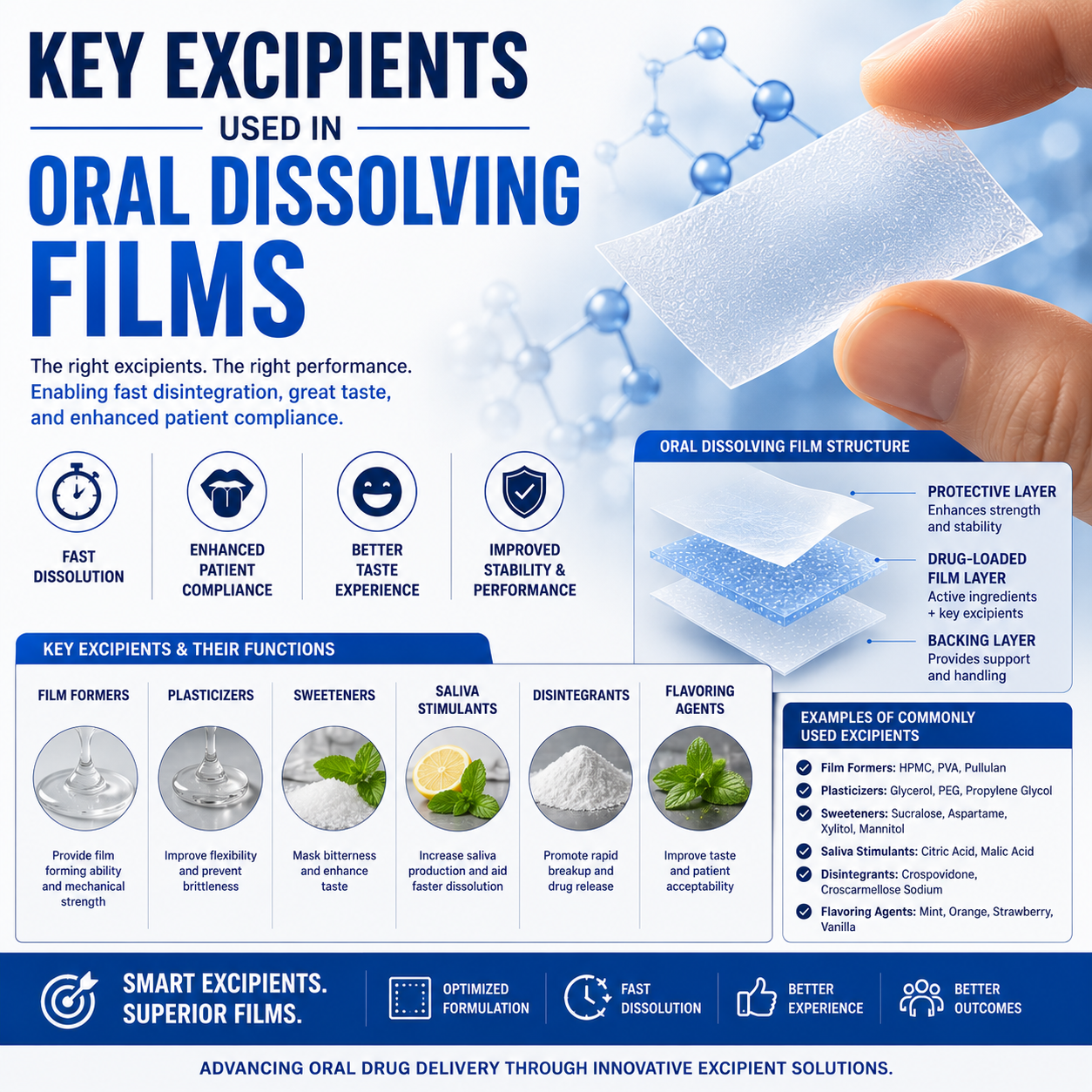
A practical guide to understanding the excipients that make fast dissolving oral films work—backed by real data and industry experience
Table of Contents
Introduction: Why Excipient Selection Makes or Breaks an OTF
The Excipient Landscape at a Glance
Film Forming Polymers: The Structural Backbone
Plasticizers: From Brittle to Flexible
Superdisintegrants: The Speed Enablers
Sweeteners, Flavoring Agents, and Taste Maskers
Surfactants and Penetration Enhancers
Saliva Stimulants and Other Functional Excipients
Industry Case Study: Developing a Palatable High Release OTF
FAQs: Common Questions About OTF Excipients
Conclusion
Introduction: Why Excipient Selection Makes or Breaks an OTF
Let me start with something I learned the hard way. Early in my career, I thought oral dissolving films were simple—just pick a polymer, add the API, cast it, and you're done.
That assumption cost me about three months of failed batches.
Oral dissolving films, also known as oral fast dissolving films or ODFs, are thin polymeric strips designed to rapidly disintegrate and release active ingredients upon contact with saliva. Unlike traditional tablets or capsules, ODFs offer advantages including faster onset, improved compliance, and ease of administration without water. But achieving these benefits requires a carefully balanced excipient system where every component plays a specific role.
The composition of an OTF consists of a variety of excipients—each playing a critical role in effective design and development. Get one wrong, and the entire film either turns into a brittle mess, tastes unbearable, or simply won't dissolve fast enough to matter.
In this article, I'm going to walk you through the key excipients used in oral dissolving films. I will cover what each type does, typical concentration ranges, real data from recent studies, and how to avoid the common pitfalls I've seen too many formulators fall into. This is not a theoretical review—it's what actually works in the lab and on the production line.
The Excipient Landscape at a Glance
Before diving deep, let me give you a high level view. A typical OTF formulation contains several excipient categories, each with a specific function and concentration range. The table below summarizes what I consider the core excipient types based on recent literature and my own formulation experience.
Excipient Category | Typical Concentration | Primary Function | Common Examples |
Film forming polymers | 30–50% (up to 65% in some formulations) | Provide mechanical strength, film structure, and disintegration control | HPMC, pullulan, maltodextrin, PVP, PVA, gelatin, sodium alginate |
Plasticizers | 0–20% | Reduce brittleness, improve flexibility and tensile strength | Glycerol, PEG 400, propylene glycol, triacetin, citrate derivatives |
Superdisintegrants | 2–5% | Accelerate film breakup upon contact with saliva | Crospovidone, sodium starch glycolate, croscarmellose sodium |
Sweeteners | 0–10% | Improve taste and patient compliance | Sucrose, sorbitol, mannitol, aspartame, sucralose, stevioside |
Saliva stimulants | 0–10% | Increase salivary flow to aid disintegration | Citric acid, ascorbic acid, malic acid, tartaric acid |
Taste maskers | 0–10% | Mask bitter or unpleasant API taste | Cyclodextrins, maltodextrin, flavors, menthol |
Surfactants | 0–10% | Enhance wetting, solubilization, and disintegration | Poloxamer 407, sodium lauryl sulfate, polysorbates(Tweens) |
Now let me break down each category in detail—because the real value is in understanding not just what goes in, but why and how much.
Film Forming Polymers: The Structural Backbone
If I had to pick one excipient category that determines whether your OTF will succeed or fail, it would be the film forming polymer. These are the core excipients used in the largest proportion—typically 30% to 50% of the total solids, and sometimes up to 60–65% depending on the desired film qualities.
The Leading Players
Here is what I've found actually works in practice:
Hydroxypropyl Methylcellulose (HPMC) —This is probably the most widely used polymer for ODFs, and for good reason. HPMC is a cellulose derivative that offers excellent film forming properties, good mechanical strength, and rapid hydration. Findings indicate that HPMC is the most suitable polymer for oral fast dissolving films. There are multiple grades available—HPMC E5, E15, K4M, and others—each offering slightly different viscosity and dissolution profiles.
Pullulan —This is a natural polymer derived from non animal sources and does not require chemical modifications. Pullulan produces films that are very transparent, have excellent film forming capacity, and remarkably low disintegration times. The trade off is cost. Around 50% to 80% w/w of pullulan can be substituted with starch during manufacturing to lower overall product cost without compromising its essential properties.
Maltodextrin and Modified Starches —These are increasingly popular, especially in nutraceutical applications. Modified maltodextrins offer rapid hydration and dissolution characteristics. Roquette has introduced LYCOAT® hydroxypropyl pea starch, which provides excellent film forming capability, mechanical strength, and disintegration performance for orally dissolving films.
Other Polymers —The combination of microcrystalline cellulose and maltodextrin has also been utilized to produce fast dissolving films. Other options include PVP, PVA, gelatin, sodium alginate, pectin, and xanthan gum.
How to Choose
Here is the decision framework I use with my clients. Start by asking three questions: (1) Is the API water soluble? If yes, HPMC or pullulan work well. (2) Is this for pharmaceuticals or nutraceuticals? This affects regulatory expectations and acceptable excipient lists. (3) What is your target disintegration time? Pullulan tends to disintegrate faster than HPMC, but HPMC offers better mechanical strength.
One more thing—polymer concentration is a critical consideration in OTF development. The stability of fast dissolving oral films hinges on the careful choice of the type and proportion of polymers used. Too little polymer and the film won't hold together. Too much, and it won't dissolve quickly enough.
Plasticizers: From Brittle to Flexible
I cannot tell you how many times I have seen a beautifully formulated film turn into a brittle, cracking mess simply because the plasticizer was wrong. Plasticizers are what give ODFs their flexibility and handling durability.
What Plasticizers Actually Do
Plasticizers improve the mechanical characteristics of the film, including tensile strength and elongation, by lowering the glass transition temperature of the polymer. They also decrease the brittleness of the strip, thereby enhancing its flexibility. Generally, the amount of plasticizer is kept at ≤20% to effectively prevent cracking and wrinkling after the film dries.
In a plasticizer screening study, researchers found that PEG 400 and propylene glycol concentrations below 10% were not sufficient to plasticize the films—the resulting films were brittle and fragmented easily. This is a classic case of "more is sometimes needed, but too much is also a problem."
Common Plasticizers and Their Trade offs
Glycerol —This is a workhorse plasticizer. A study using deacylated gellan gum varied glycerol from 20% to 75% w/w to obtain films with tunable mechanical properties and high drug loading efficiency. Research has shown that glycerin is a more efficient plasticizer than PEG in some systems, but it can also increase moisture sensitivity.
Polyethylene Glycol (PEG) —Low molecular weight PEGs (particularly PEG 400) are commonly used. However, compatibility matters: cellulose hydrophilic derivatives as film forming materials are very sensitive to plasticizers containing hydroxyl groups, such as PEG.
Propylene Glycol —This is another standard option, though it can produce brittle films in certain polymer systems if the polarity doesn't match well.
Citrate Derivatives —Triacetin, acetyl citrate, triethyl citrate, and tributyl citrate are also used, particularly when lower hygroscopicity is desired.
A Critical Warning
Improper application of plasticizers can result in issues like blooming (migration to the film surface), cracking, splitting, and peeling of the film. I once worked on a project where we used too much PEG 400—the films felt great immediately after drying, but after two weeks of storage at room temperature, they were sticky and had begun to delaminate. We had to go back and re optimize the entire plasticizer concentration.
Superdisintegrants: The Speed Enablers
In the world of oral dissolving films, speed is everything. Patients expect the film to disappear within seconds, not minutes. That is where superdisintegrants come in.
What Are Superdisintegrants?
Superdisintegrants are excipients that rapidly swell or wick water into the film matrix, causing it to break apart almost instantly upon contact with saliva. Even though ODTs (orally disintegrating tablets) are a different dosage form, the mechanisms are similar—and the data is instructive.
The Key Players for ODFs
Crospovidone —This crosslinked polyvinylpyrrolidone is extremely effective. In a direct comparison of superdisintegrants for orally disintegrating tablets, crospovidone showed the fastest wetting time at just 9–12 seconds, compared to 17–21 seconds for sodium starch glycolate and croscarmellose sodium. The quick wetting was attributed to strong capillary characteristics of crospovidone.
For ODFs, crospovidone has shown excellent results. A 2022 study on levocetirizine dihydrochloride fast dissolving films found that the formulation containing crospovidone showed the highest percentage of drug release (100.54% ± 1.47 within 3 minutes).
Sodium Starch Glycolate —This is highly efficient at low concentration levels (2–5% w/w) for facilitating tablet and film disintegration. It swells significantly upon contact with water.
Croscarmellose Sodium —This crosslinked carboxymethylcellulose sodium is another standard option, though generally slightly slower than crospovidone in comparative studies.
Selection Strategy
When I help formulators choose a superdisintegrant, I usually recommend starting with crospovidone for maximum speed, then adjusting based on compatibility with the API and polymer system. It is worth noting that superdisintegrants are "highly efficient at low concentration levels", which means you do not need to use large amounts to get the effect. That is good news because it leaves more room in the formulation for other components.
Sweeteners, Flavoring Agents, and Taste Maskers
Let me be blunt: patients will not take a bitter film. They just won't. And I have seen more than one otherwise excellent OTF program fail at clinical trials solely because patients complained about taste.
Sweeteners: The First Line of Defense
Sweeteners play a crucial role in formulations designed to disintegrate or dissolve in the mouth. Generally, sweeteners are utilized at concentrations ranging from 3% to 6% w/w, either individually or in combination. Both natural and artificial sweeteners are used, but there is an important caveat: natural sugars should be limited in preparations intended for people on a diet or individuals with diabetes.
The artificial sweetener landscape has evolved significantly. First generation artificial sweeteners include saccharin, cyclamate, and aspartame. Second generation options include acesulfame K, sucralose, alitame, and neotame. The potency differences are dramatic—acesulfame K and sucralose are over 200 and 600 times sweeter than sucrose, respectively, while neotame and alitame exceed 2000 and 8000 times.
Flavoring Agents
I always recommend using flavor systems that complement the drug's inherent taste profile. Citrus, mint, and berry flavors are popular for a reason—they work well with a wide range of APIs.
Taste Maskers for Difficult APIs
For extremely bitter drugs, sweeteners and flavors alone are often not enough. That is where dedicated taste masking excipients come in.
Cyclodextrins (including hydroxypropyl β cyclodextrin and sulfobutylether β cyclodextrin) are highly effective because they form inclusion complexes that physically trap the bitter API molecule, preventing it from interacting with taste receptors.
A 2022 study on levocetirizine fast dissolving films demonstrated that solid dispersion with gelatin provided significantly better taste masking than non solid dispersed formulations. Human participants reported a marked improvement in palatability for the solid dispersed FDF.
Practical Guidance
Here is what I tell my clients about taste management. First, always test taste performance with human panels early—don't rely solely on in vitro data. Second, consider layering multiple mechanisms: sweeteners for immediate sweetness, flavors for the overall sensory experience, and cyclodextrins or solid dispersion for the toughest bitter compounds. Third, remember that excipient concentrations can be adjusted within the 0–10% range for each category, but you need to balance them without exceeding the total formulation space.
Surfactants and Penetration Enhancers
Surfactants serve two important purposes in ODFs. First, they act as wetting, solubilizing, or dispersing agents to ensure that the film dissolves rapidly and releases the active ingredient promptly. Second, for buccal or sublingual absorption, certain surfactants can enhance permeation through the oral mucosa.
Commonly Used Surfactants
Frequently used surfactants include poloxamer 407 (the most commonly used), sodium lauryl sulfate, polysorbates (Tweens), and benzalkonium chloride. Poloxamer is particularly versatile because it also has some taste masking properties.
Penetration Enhancers for Mucosal Absorption
For APIs that are intended to be absorbed through the buccal or sublingual mucosa rather than swallowed, penetration enhancers become important. Surfactants, bile salts, and fatty acids have been shown to enhance drug transport through the oral mucosa.
The mechanism varies by class: anionic surfactants like sodium lauryl sulfate disrupt intercellular lipids and protein integrity, while non ionic surfactants like polysorbates interact with keratin fibrils causing swelling of the epithelium. Bile salts penetrate intercellular regions, increase membrane fluidity, and can extract lipids.
A Note of Caution
While penetration enhancers can dramatically improve bioavailability, higher concentrations may cause mucosal irritation. The typical range is 0–10%. I always recommend conducting cytotoxicity or irritation studies early when using these excipients at the higher end of the range.
Saliva Stimulants and Other Functional Excipients
Saliva Stimulants (Sialagogues)
One of the less discussed but critical excipient categories is saliva stimulants. These compounds increase salivary flow, which in turn accelerates film disintegration and drug release. Common examples include citric acid, ascorbic acid, tartaric acid, malic acid, and lactic acid, typically used at 0–10% concentrations.
Citric acid is particularly popular because it not only stimulates saliva but also provides a pleasant sour note that complements fruit flavors.
Other Functional Excipients
Depending on the specific application, ODFs may also include:
Preservatives (e.g., parabens, benzoic acid) for multi dose or multi use packaging
Colors for product identification or aesthetic appeal
pH adjusters to maintain API stability and optimize dissolution
Filler/bulking agents such as mannitol or sorbitol, which also contribute to sweetness and texture
Regulatory Compliance Requirements
Here is something every formulator must know: from the regulatory point of view, all the excipients used should be generally regarded as safe (GRAS) listed and should be used as per Inactive Ingredients Limit (IIG limit). In June 2025, the FDA issued a proposed order for minor dosage form changes from tablets or capsules to ODTs or films, signaling that films are now being treated as a mainstream dosage form category. This increases regulatory scrutiny—but also provides clearer pathways.
Industry Case Study: Developing a Palatable High Release OTF
Let me walk you through a real study that shows how excipients come together in practice.
The Context: A 2022 study developed fast dissolving films for levocetirizine dihydrochloride (LCD), a bitter tasting antihistamine with delayed onset. The goal was to create a palatable film with rapid disintegration and drug release.
The Excipient Strategy: The formulation used HPMC as the film forming polymer. Superdisintegrants (sodium starch glycolate, croscarmellose sodium, and crospovidone) were evaluated. Crospovidone performed best, achieving 100.54% ± 1.47 drug release within 3 minutes. For taste masking, the researchers created a 1:1 solid dispersion of LCD with gelatin, which disrupted the drug's crystalline structure and formed intermolecular hydrogen bonds.
The Results: The optimized formulation (LF-7) showed rapid in vitro disintegration at 25 seconds and, remarkably, just 9.43 ± 2.16 seconds in human participants. Taste masking was significantly improved compared to non solid dispersed formulations. Stability studies showed the films remained stable for three months.
Key Takeaway: This case illustrates the power of combining the right film forming polymer (HPMC), the right superdisintegrant (crospovidone), and an effective taste masking strategy (solid dispersion with gelatin). Each excipient played a specific role, and the sum delivered a product that was both fast and palatable.
FAQs: Common Questions About OTF Excipients
Q1: What is the most important excipient in an oral dissolving film?
The film forming polymer is arguably the most critical because it provides the structural backbone. Among polymers, HPMC and pullulan are the most widely used and best studied. However, "most important" depends on your formulation goals—for a bitter drug, taste masking excipients might be equally critical.
Q2: How do I choose between HPMC and pullulan?
HPMC is lower cost and offers good mechanical strength. Pullulan produces faster disintegration and better transparency but is more expensive. About 50–80% of pullulan can be replaced with starch to reduce cost without losing its key properties. If cost is a primary concern, start with HPMC or HPMC/starch blends.
Q3: What plasticizer concentration should I start with?
Start with 10–15% as a baseline, then adjust based on mechanical testing. Concentrations below 10% often produce brittle films, while concentrations above 20% risk stickiness and blooming issues. Always perform stability studies because plasticizer effects can change over time.
Q4: How do superdisintegrants differ from disintegrants for ODFs vs. tablets?
Superdisintegrants work through similar mechanisms (capillary action, swelling, and wicking), but ODFs require much faster action because they have less mass. Crospovidone's strong capillary characteristics make it particularly effective for films. I typically recommend starting with crospovidone at 2–5% w/w.
Q5: Are all excipients GRAS-compliant?
Regulatory compliance requires that all excipients be approved for oral pharmaceutical use. Excipients must be generally regarded as safe (GRAS) listed and should be used within Inactive Ingredients Limit (IIG) guidelines. When selecting excipients, always check the current IIG database and consult regulatory guidelines for your target markets.
Q6: Can I use natural sweeteners instead of artificial ones?
Yes, but with caveats. Natural sugars like sucrose and fructose should be limited in products intended for diabetic patients or individuals on restricted diets. For general consumer products, a combination of natural and artificial sweeteners often works best—artificial sweeteners provide high sweetness intensity without calories, while natural sugars offer better mouthfeel.
Q7: How do saliva stimulants affect film performance?
Saliva stimulants like citric acid increase salivary flow, which accelerates disintegration and drug release. A 5–10 second reduction in disintegration time is achievable with proper use. However, too much can make the film overly acidic, potentially affecting API stability or causing mucosal irritation.
Q8: What is the regulatory status of OTF excipients following the 2025 FDA guidance?
The FDA's June 2025 proposed order for minor dosage form changes from tablets or capsules to films signals increased regulatory acceptance of films as a mainstream category. This does not change excipient compliance requirements—GRAS listing and IIG limits still apply—but it does create a clearer pathway for reformulations, which may expand the range of approved excipient combinations.
Conclusion
Selecting the right excipients for an oral dissolving film is not about memorizing a list. It is about understanding how each component contributes to the final product's performance and balancing competing priorities.
The film forming polymer gives the film its structure. Plasticizers make it flexible enough to handle. Superdisintegrants make it disappear quickly in the mouth. Sweeteners, flavors, and taste maskers make it palatable enough that patients will actually use it. Surfactants and penetration enhancers make sure the drug gets absorbed when it matters. Saliva stimulants speed everything up.
The data is clear. With HPMC or pullulan as the backbone, crospovidone at 2–5% for speed, carefully selected plasticizers at 10–15%, and a multi layer taste masking approach that includes cyclodextrins or solid dispersion for bitter APIs, you can achieve films that disintegrate in under 30 seconds and deliver complete drug release within minutes—while remaining stable, manufacturable, and pleasant to use.
The field is moving fast. New excipients are emerging, like Roquette's pea starch film forming agents and advanced cyclodextrin derivatives for taste masking and solubilization. Regulatory pathways are becoming clearer with the FDA's 2025 guidance. Market demand is growing across pharmaceuticals, nutraceuticals, and consumer health.
But the fundamentals I have covered here—what each excipient does, how much to use, and how to avoid the common mistakes—will serve you regardless of how the technology evolves.