June 27, 2026
What Pharmaceutical Companies Look for in an Oral Thin Film Manufacturer
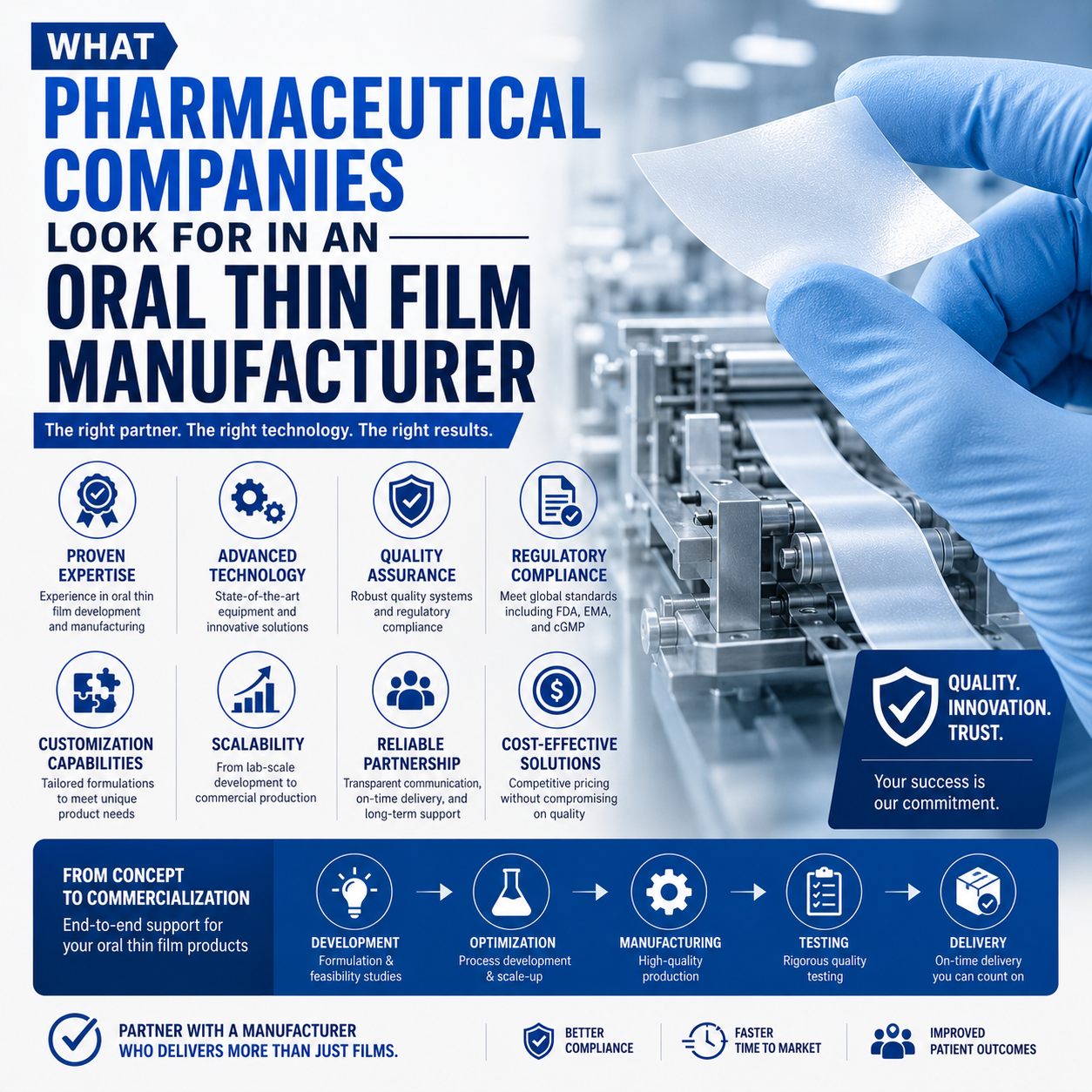
A technical guide to selecting the right CDMO partner for OTF development and commercialization
Table of Contents
Introduction: A Decision That Determines Program Success
Technical and Formulation Capability
Quality Systems and GMP Readiness
Scalability and Technology Transfer
Regulatory Expertise and Track Record
Business Considerations and Long-term Partnership
Industry Case Study: LTS and Nualtis Strategic Partnership
FAQs: What Sponsors Ask Before Signing a CDMO Contract
Conclusion
Introduction: A Decision That Determines Program Success
Let me start with a blunt observation. Over the past few years, I have sat in more than a few project review meetings where a perfectly good oral thin film program was delayed—or worse, shelved—because the manufacturer wasn't up to the task.
The global oral thin films market is growing fast. Current estimates put it at around USD 3.80 billion in 2026, with projections reaching USD 7.93 billion by 2034 at a CAGR of 9.62% [14†L14-L16]. Other analyses show even more aggressive growth: USD 6.1 billion in 2025 expanding to USD 17.2 billion by 2034 [15†L5-L6]. That level of growth has attracted a lot of players into the OTF manufacturing space. But not all of them are ready for what pharmaceutical companies actually need.
So what do pharma companies look for when selecting an oral thin film manufacturer?
I have been on both sides of this table—as a sponsor evaluating CDMOs and as a technical advisor helping CDMOs prepare for audits. The criteria are surprisingly consistent across big pharma, specialty pharma, and emerging biotech. This guide walks you through the six core domains that really matter.
Technical and Formulation Capability
This is where many evaluation processes start, and for good reason. Manufacturing oral thin films at scale is complex. It requires precise control over polymer composition, drug loading, film thickness, and dissolution rate [8†L24-L26]. Minor variations can lead to inconsistent dosing or altered pharmacokinetics.
API Handling Versatility
A capable oral thin film manufacturer must demonstrate experience across a range of APIs—including poorly soluble, hydrophilic, and heat sensitive compounds [8†L30-L31]. This matters because OTFs were traditionally limited to low dose, highly soluble drugs. Today's sponsors bring formulations that push those boundaries: high load drugs, BCS Class II compounds, and even biologics.
In June 2025, BioNxt Solutions announced a feasibility study for an oral dissolvable film formulation of semaglutide—a GLP 1 receptor agonist that currently dominates the diabetes and obesity markets [22†L9-L11]. That is not your grandfather's OTF. Manufacturers who cannot handle complex APIs will be left behind.
Taste Masking and Patient Acceptability
Taste masking is non negotiable. Patients will not take a bitter film, no matter how fast it dissolves. A manufacturer should be capable of applying multiple taste masking strategies—ion exchange resin complexation, barrier coating, or sophisticated flavor systems [8†L32].
Release Profile Engineering
Beyond immediate dissolution, sponsors increasingly request sustained release or buccal delivery profiles [10†L20-L23]. The right CDMO must be able to tune release kinetics through polymer selection, multilayer casting, or matrix design.
Quality Systems and GMP Readiness
Let me be direct about this. You cannot cut corners on quality. An OTF's large surface area, hygroscopic nature, and dose critical characteristics demand a manufacturing platform fully aligned with GMP expectations [11†L5-L8].
What GMP Readiness Actually Means
Building a GMP ready ODF manufacturing capability means treating thin films as a high precision, high visibility dosage form. Quality is engineered via Quality by Design (QbD), supported by robust facilities, qualified equipment, controlled coating–drying–packing processes, and strong packaging [11†L13-L17].
Sponsors should look for:
IQ/OQ/PQ documentation for all critical equipment [1†L19-L21]
Validated analytical methods for API content, dissolution rate, and content uniformity across the film web [8†L54-L57]
Inline monitoring systems that track thickness, moisture, and defects in real time [11†L43-L45]
Cleaning validation protocols for shared equipment lines [11†L42-L43]
Traceability and Data Integrity
A capable OTF manufacturer implements end to end traceability: from raw material receipt to weighing to solution batch to coating run to finished pack [11†L46-L49]. This means electronic batch records with audit trails, role based access controls, and—for high risk products—serialization or unit level traceability [11†L45-L50].
Scalability and Technology Transfer
Here is where many CDMOs fail. A manufacturer can make beautiful films in the lab—five batches, perfect results. But can they scale that process to commercial volumes without losing control?
From Pilot to Commercial
A good OTF manufacturer should be able to transition seamlessly from pilot batches to full scale commercial production while maintaining consistent product quality [10†L28-L30]. This requires:
Scalable process technologies (solvent casting, hot melt extrusion, or multilayer film formation) [10†L26-L28]
Sufficient capacity to accommodate increased production volumes without compromising quality standards [9†L35-L38]
Clear technology transfer protocols that document every process parameter
The technology transfer process itself is valuable: it helps transform small, experimental batches into consistent production capable of delivering higher volumes [9†L53-L55].
Real World Example
Take the 2025 strategic collaboration between LTS LOHMANN Therapie Systeme AG and Nualtis. The partnership leverages LTS's global expertise in technology transfer, scale up, and manufacturing to help Nualtis scale their innovative OTF products and deliver them to patients worldwide [3†L23-L27]. This is exactly the kind of capability sponsors are looking for.
Regulatory Expertise and Track Record
Your manufacturer's regulatory history is your regulatory history.
Global Compliance Standards
Compliance with GMP, FDA, EMA, and WHO standards is non negotiable [8†L47-L48]. The CDMO should have a track record of working with regulatory bodies in your target markets and be familiar with relevant regulatory frameworks to efficiently navigate compliance [9†L28-L31].
What to Ask About Regulatory History
When I evaluate a potential OTF partner, I ask for specific documentation:
Inspection history: Has the facility received FDA Form 483 observations? If yes, how did they respond? The key quality metric is CAPA effectiveness—measured in on time investigation and task completion—which tells the story of the CDMO's commitment to continuous improvement [13†L45-L47].
Deviation closure times: Chronic failure to close deviations within the standard window may indicate an under resourced quality unit [13†L48-L50].
Batch record cycle times: Prolonged cycles can threaten clinical or commercial timelines [13†L50-L52].
FDA's Evolving Stance on OTFs
In June 2025, the FDA issued a proposed monograph order for OTC drugs in orally disintegrating tablet and film dosage forms, along with a draft guidance for industry on minor changes to solid oral dosage forms [4†L4-L18]. This signals increasing regulatory acceptance of films as a mainstream category, which is good news for sponsors—but it also means manufacturers must stay current on evolving requirements.
Business Considerations and Long term Partnership
Technical capability alone is not enough. Pharmaceutical companies are not looking for a transactional vendor; they are looking for a strategic partner.
Capacity and Right First Time Performance
Capacity and technical capability are important because they drive right first time performance and indicate whether a CDMO can support a product throughout development and commercialization [13†L13-L15]. That means fewer failed batches, fewer deviations, and faster time to market.
Financial Stability and Ownership Structure
A CDMO's ownership structure can be indicative of its financial health, the stability of its C suite, and the business's general health [13†L28-L30]. Ask about the CDMO's long term objectives, capital investment to date, and revenue reinvestment plans [13†L38-L40].
Project Management and Communication
Clear, structured communication is essential. A pharmaceutical partner for oral thin film R&D should deliver accurate timelines, transparent communication, and a proven track record of guiding molecules through to commercialization [17†L17-L18].
End to End vs. Specialized Support
Some sponsors prefer an end to end CDMO—a one stop shop that handles everything from early formulation through commercial manufacturing, analytical testing, regulatory filing support, and supply chain coordination [12†L46-L52]. Others need specialized support for specific development phases. The right fit depends on your program's stage and complexity.
Industry Case Study: LTS and Nualtis Strategic Partnership
A real world example helps bring these criteria to life.
The Context: Nualtis had developed innovative OTF formulations but needed large scale manufacturing capacity to bring their products to global markets. LTS LOHMANN Therapie Systeme AG had established global expertise in technology transfer, scale up, and GMP compliant OTF manufacturing.
The Partnership: In June 2025, the two companies announced a strategic collaboration to provide robust, high quality large scale manufacturing capabilities for oral thin film drug delivery technologies [3†L29-L34]. The partnership leveraged LTS's global manufacturing expertise to help Nualtis scale their innovative OTF products [3†L22-L27].
What This Illustrates: Pharmaceutical companies look for CDMOs that complement their own capabilities. Nualtis brought formulation innovation; LTS brought scale, regulatory experience, and global reach. The partnership structure allowed Nualtis to access commercial manufacturing without building their own facilities.
The Takeaway: The ideal OTF manufacturer does not just execute a process. It brings strategic value—whether through technology transfer expertise, global regulatory knowledge, or access to specialized equipment that would be too expensive for a sponsor to acquire independently.
FAQs: What Sponsors Ask Before Signing a CDMO Contract
Q1: What manufacturing technologies should an OTF CDMO have in its toolkit?
At minimum, look for solvent casting (the industry standard), hot melt extrusion for poorly soluble APIs, and preferably multilayer film formation for complex release profiles [8†L37-L38]. Advanced capabilities like nano milling or microfluidisation for liposomal delivery are valuable differentiators [8†L40-L42].
Q2: How do I verify a CDMO's GMP readiness?
Ask for their IQ/OQ/PQ documentation for all critical equipment. Request inspection history for FDA, EMA, or other relevant agencies. Review their deviation closure rates and batch record cycle times. A CDMO that cannot provide this data transparently is a red flag.
Q3: What quality control tests should an OTF manufacturer perform in line?
Standard inline QC includes thickness monitoring (laser micrometers), moisture measurement (NIR), and visual inspection for defects. Off line testing should include content uniformity, disintegration time, mechanical strength, and stability studies under varied temperature/humidity conditions [8†L49-L52].
Q4: How important is analytical capability in a CDMO?
This is often underestimated. A well staffed analytical group with sufficient instrumentation should be near the top of any list of requirements for CDMO selection [0†L44-L46]. Without robust analytics, you cannot validate your process or support regulatory submissions.
Q5: What should I look for in a CDMO's supply chain?
Evaluate their material traceability (from incoming excipients to final pack), packaging validation (especially moisture barrier for hygroscopic OTFs), and capacity for increased production volumes as your program advances from clinical to commercial phases [9†L35-L38].
Q6: How does a CDMO's size affect my decision?
Larger CDMOs typically offer broader capabilities, global regulatory reach, and greater financial stability. Smaller CDMOs may provide more flexibility and faster decision making. The right choice depends on your program's stage, complexity, and volume projections [12†L46-L52].
Conclusion
Selecting the right oral thin film manufacturer is one of the most critical strategic decisions a pharmaceutical sponsor will make. The wrong choice leads to delayed timelines, regulatory setbacks, failed batches, and—worst of all—a product that never reaches patients.
What do pharma companies actually look for? In my experience, the answer comes down to six interconnected domains: technical formulation capability that can handle complex APIs and release profiles; GMP ready quality systems with full traceability and data integrity; scalable manufacturing that transitions smoothly from pilot to commercial; regulatory expertise backed by a clean inspection history; financial stability and long term commitment; and strategic partnership—not just transactional execution.
The market is growing. New entrants appear every year. But the manufacturers that will win long term partnerships are those that invest in quality, scale intelligently, and communicate transparently. As the LTS Nualtis collaboration demonstrates, the most successful relationships are built on complementary strengths and shared long term objectives.
So here is my advice: do your homework. Visit the facility. Ask the hard questions about inspection histories and deviation closures. Validate their analytical capabilities. And most importantly, treat the CDMO selection process as a strategic partnership decision, not a procurement exercise. Your program's success depends on it.